
Advancing the unification of probability, curvature, and quantum emergence through Entanglement Compression Theory (ECT).
Committed to open access to knowledge – not centralized ownership.

Compression Theory Institute
For a thing to exist, it must persist; and to persist, it must evolve without destroying what makes it itself.
To be is to evolve.
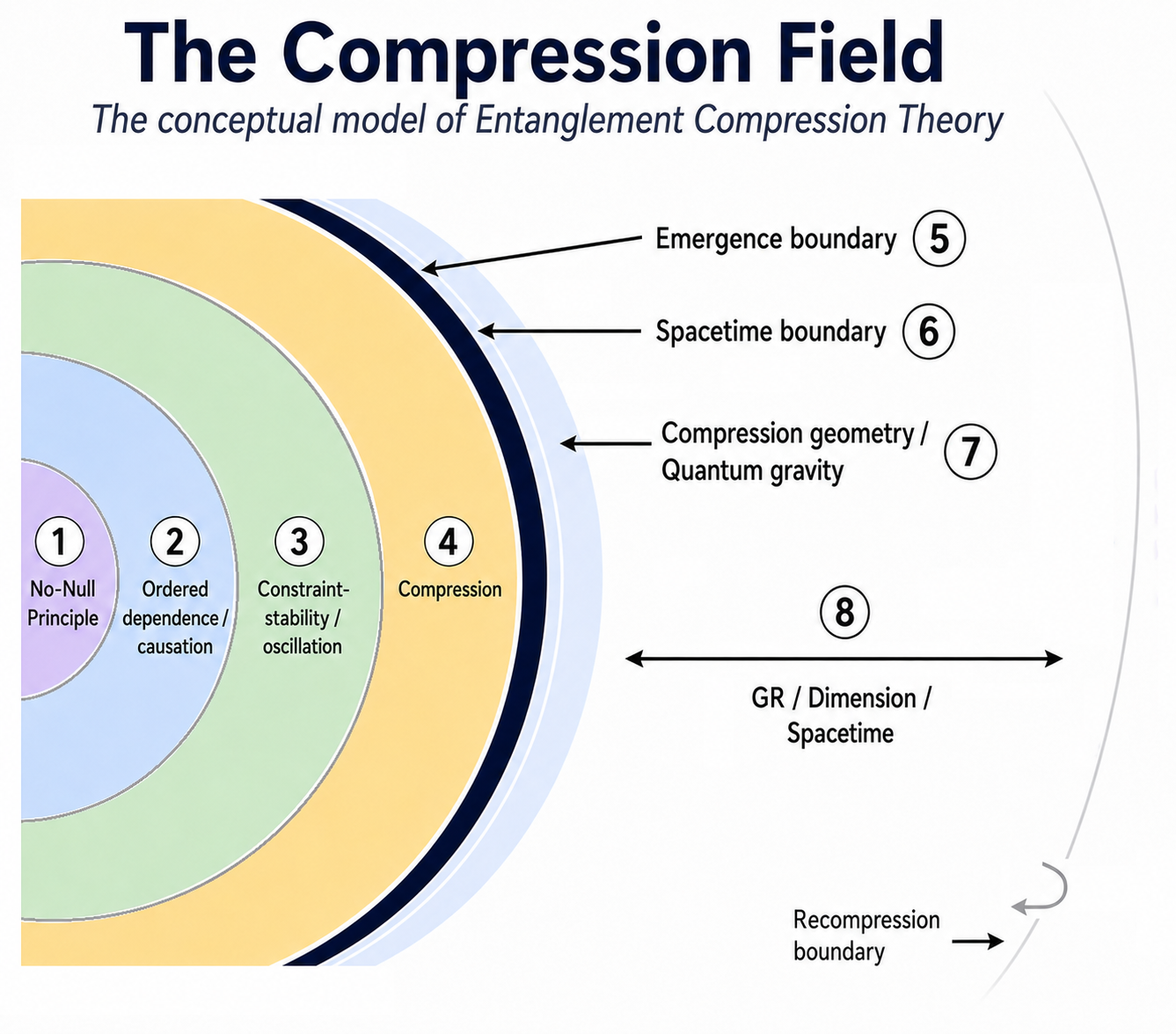
Current research state
Entanglement Compression Theory is now organized as a staged reconstruction program linking boundary-derived probability, finite recurrent stability, compression geometry, numerical structure formation, and deterministic quantum gravity.
The latest work closes the formal ECT route to quantum gravity by showing how Boundary Loss, compression readout, tensor-admissible geometry, and source-to-geometry role structure combine into a deterministic Deterministic Quantum Gravity framework. This establishes the base-layer stability required for the next source-response and Einstein-equation-facing recovery module.
The foundation work also separates two problems that were previously intertwined: how probability can arise inside a deterministic description, and how closed recurrent systems preserve recoverable identity without external clocks, labels, or observers.
Latest Updates
Foundation trilogy
The Origin of Probability: A Complete Derivation in Three Parts
This three-paper sequence develops the structural route from persistent recoverable identity, through boundary-readable numerical probability, to Boundary Loss, local predictive probability, and the exact local source-linked Born form.
Part I establishes finite recurrent stability: what must persist, what must be corrected and carried through, what may recur, and how collapse, emergence, horizons, and cycle-index nonrecoverability are classified before physical realization is assumed.
Part II asks when persistent deterministic structure can become boundary-readable and support conditional numerical probability-measure status. It separates readable alternatives, scalar weighting, event measure, normalization, and probability interpretation.
Part III develops recoverability-relevant Boundary Loss and lawful unresolved alternatives, then carries them through source-grounded finite measure, local predictive probability, independent source-Hilbert bridges, and an explicit compatibility commitment to the exact local source-linked Born form.
Mathematical and DQG layer
Mathematical Foundations and Formal Framework Closure
The mathematical framework establishes the dependency-ordered ECT core through ordered dependence, compression dynamics, closed scalar content, boundary erasure, local scalarization, local Born-form recovery, and spacetime-emergence setup.
The DQG page presents the formal closure of the ECT framework through wave ontology, compression readout, tensor-admissible geometry, effective metric response, compression stress-energy, admitted narrowed conservation bridge, Einstein-extension status, deterministic quantum gravity, and downstream dark-sector phase-share structure.
AIPR
AI Physics Review
AIPR provides structured mechanical triage and audit for theoretical physics manuscripts using independent model runs and transparent aggregation.
Simulation
Deterministic Structure Formation
Public PWE simulations test whether deterministic compression dynamics can generate stable halo, localization, and galaxy-scale structure without external potentials, stochastic terms, or imposed symmetry.
Research tracks
Probability and boundary observability
Probability is treated as an emergent boundary measure, not as a primitive postulate or unconstrained bulk energy division.
Recurrence, stability, and horizons
Closed systems are analyzed through recoverable identity, finite recurrent stability, collapse, emergence, and boundary-readable structure.
Compression geometry
Compression is modeled through amplitude-derived scalar and tensor structures that induce effective metric response and curvature diagnostics.
Numerical structure formation
Public simulation datasets test whether deterministic compression dynamics can generate stable halos, localization, and galaxy-scale structure.
What is Entanglement Compression Theory?
Entanglement Compression Theory (ECT) is a proposed deterministic framework for explaining how observable structure, probability, curvature, matter, and spacetime-scale organization may arise from compression-governed wave dynamics. The basic claim is that spacetime is not the starting point. It is the readable expression of deeper order.
ECT is organized to be read in layers. The public overview begins with the conceptual picture, then moves into the formal structure, and then into the source papers that support each step of the reconstruction.
The current ECT program is not presented as one overloaded proof. It is divided into separate modules: probability and boundary observability, recurrence and recoverability, compression geometry, deterministic quantum gravity, and numerical structure formation.
Publication index
This index is organized by role in the ECT reconstruction program. Individual paper pages provide abstracts, technical summaries, DOI links, and downloads.
Foundations
Mathematical and quantum-gravity framework
Bridge papers and technical notes
Numerical simulations and public datasets
Under the Primordial Wave Equation with the ECT compression field, perturbed initial conditions evolve into stable compression-supported structures. The published datasets include scripts, figures, snapshots, and reproduction guides.
Deterministic structure formation under the Primordial Wave Equation. No external potentials, stochastic terms, or symmetry constraints are imposed.
Stage-1: Halo and singularity formation | Stage-2: Singularity to galaxy formation
Open access archive
Zenodo community
Canonical public archive for CTI and ECT papers, datasets, figures, and reproduction materials.
OSF project
Project-level archive and continuity hub for public research materials.
Author profiles
Research profiles and indexing pages for William Andrew Lawrence.
Explore the foundational physics concepts addressed by Entanglement Compression Theory .